- java.lang.Object
-
- reactor.core.publisher.Hooks.OperatorHook<T>
-
-
Method Summary
All Methods Instance Methods Concrete Methods Modifier and Type Method and Description Hooks.OperatorHook<T>doOnEach(Consumer<? super T> onNextCall, Consumer<? super Throwable> onErrorCall, Runnable onCompleteCall, Runnable onAfterTerminateCall)Peek into sequence signals.Hooks.OperatorHook<T>doOnLifecycle(Consumer<? super Subscription> onSubscribeCall, LongConsumer onRequestCall, Runnable onCancelCall)Peek into lifecycle signals.Hooks.OperatorHook<T>ifFlux()Apply hook only ifpublisher()isFluxHooks.OperatorHook<T>ifMono()Apply hook only ifpublisher()isMonoHooks.OperatorHook<T>ifName(String... names)Apply hook only if one of the provided names matches the operator underlying type name (case insensitive, without Mono/Flux prefix or Fuseable suffix).Hooks.OperatorHook<T>ifNameContains(String... names)Apply hook only if one of the provided names is contained in the operator's underlying type name (case insensitive, without Mono/Flux prefix or Fuseable suffix).Hooks.OperatorHook<T>ifParallelFlux()Apply hook only ifpublisher()isParallelFluxHooks.OperatorHook<T>ignore()Discard allHooks.OperatorHookapplied to the currentpublisher()Hooks.OperatorHook<T>log(String category, boolean showOperatorLine, SignalType... options)Observe Reactive Streams signals matching the passed filteroptionsand log them at INFO level.Hooks.OperatorHook<T>log(String category, Level level, boolean showOperatorLine, SignalType... options)Observe Reactive Streams signals matching the passed filteroptionsand log them at the provided level.Hooks.OperatorHook<T>log(String category, Level level, SignalType... options)Observe Reactive Streams signals matching the passed filteroptionsand log them at the provided level.Hooks.OperatorHook<T>log(String category, SignalType... options)Observe Reactive Streams signals matching the passed filteroptionsand log them at INFO level.Hooks.OperatorHook<T>operatorStacktrace()Enable operator stack recorder that captures a declaration stack whenever an operator is instantiated.Publisher<T>publisher()The publisher being decorated
-
-
-
Method Detail
-
doOnEach
public final Hooks.OperatorHook<T> doOnEach(Consumer<? super T> onNextCall,
                                            Consumer<? super Throwable> onErrorCall,
                                            Runnable onCompleteCall,
                                            Runnable onAfterTerminateCall)
Peek into sequence signals.The callbacks are all optional.
- Parameters:
onNextCall- A consumer that will observeSubscriber.onNext(Object)onErrorCall- A consumer that will observeSubscriber.onError(Throwable)}onCompleteCall- A task that will run onSubscriber.onComplete()onAfterTerminateCall- A task will run after termination viaSubscriber.onComplete()orSubscriber.onError(Throwable)- Returns:
- an observing
Hooks.OperatorHook
-
doOnLifecycle
public final Hooks.OperatorHook<T> doOnLifecycle(Consumer<? super Subscription> onSubscribeCall,
                                                 LongConsumer onRequestCall,
                                                 Runnable onCancelCall)
Peek into lifecycle signals.The callbacks are all optional.
- Parameters:
onSubscribeCall- A consumer that will observeSubscriber.onSubscribe(Subscription)onRequestCall- A consumer of long that will observeSubscription.request(long)}onCancelCall- A task that will run onSubscription.cancel()- Returns:
- an observing
Hooks.OperatorHook
-
ignore
public final Hooks.OperatorHook<T> ignore()
Discard allHooks.OperatorHookapplied to the currentpublisher()- Returns:
- an ignoring
Hooks.OperatorHook
-
ifFlux
public final Hooks.OperatorHook<T> ifFlux()
Apply hook only ifpublisher()isFlux- Returns:
- a possibly ignoring
Hooks.OperatorHook
-
ifMono
public final Hooks.OperatorHook<T> ifMono()
Apply hook only ifpublisher()isMono- Returns:
- a possibly ignoring
Hooks.OperatorHook
-
ifParallelFlux
public final Hooks.OperatorHook<T> ifParallelFlux()
Apply hook only ifpublisher()isParallelFlux- Returns:
- a possibly ignoring
Hooks.OperatorHook
-
ifName
public final Hooks.OperatorHook<T> ifName(String... names)
Apply hook only if one of the provided names matches the operator underlying type name (case insensitive, without Mono/Flux prefix or Fuseable suffix).- Parameters:
names- a list of possible names that would match if equal- Returns:
- a possibly ignoring
Hooks.OperatorHook
-
ifNameContains
public final Hooks.OperatorHook<T> ifNameContains(String... names)
Apply hook only if one of the provided names is contained in the operator's underlying type name (case insensitive, without Mono/Flux prefix or Fuseable suffix).- Parameters:
names- a list of possible names that would match if contained- Returns:
- a possibly ignoring
Hooks.OperatorHook
-
log
public Hooks.OperatorHook<T> log(String category,
                                 SignalType... options)
Observe Reactive Streams signals matching the passed filteroptionsand log them at INFO level.Logging it done through
Loggerso the default logging framework isjava.util.logging, but if SLF4J is available it will be used instead.Options allow fine grained filtering of the traced signal, for instance to only capture onNext and onError:
     Operators.signalLogger(source, "category", Level.INFO, SignalType.ON_NEXT,
 SignalType.ON_ERROR)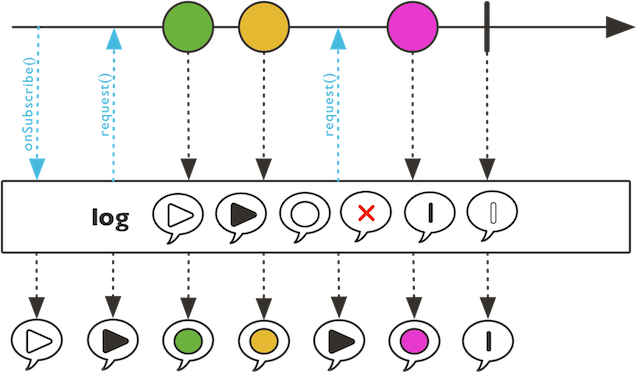
- Parameters:
category- to be mapped into logger configuration (e.g. org.springframework.reactor). If category is null, empty or ends with "." like "reactor.", a generated operator suffix will complete, e.g. "reactor.Flux.Map".options- a varargSignalTypeoption to filter log messages- Returns:
- a logging
Hooks.OperatorHook
-
log
public Hooks.OperatorHook<T> log(String category,
                                 boolean showOperatorLine,
                                 SignalType... options)
Observe Reactive Streams signals matching the passed filteroptionsand log them at INFO level.Logging it done through
Loggerso the default logging framework isjava.util.logging, but if SLF4J is available it will be used instead.Options allow fine grained filtering of the traced signal, for instance to only capture onNext and onError:
Operators.signalLogger(source, "category", Level.INFO, SignalType.ON_NEXT, SignalType.ON_ERROR)- Parameters:
category- to be mapped into logger configuration (e.g. org.springframework.reactor). If category is null, empty or ends with "." like "reactor.", a generated operator suffix will complete, e.g. "reactor.Flux.Map".showOperatorLine- capture the current stack to display operator class/line number.options- a varargSignalTypeoption to filter log messages- Returns:
- a logging
Hooks.OperatorHook
-
log
public Hooks.OperatorHook<T> log(String category,
                                 Level level,
                                 SignalType... options)
Observe Reactive Streams signals matching the passed filteroptionsand log them at the provided level.Logging it done through
Loggerso the default logging framework isjava.util.logging, but if SLF4J is available it will be used instead.Options allow fine grained filtering of the traced signal, for instance to only capture onNext and onError:
Operators.signalLogger(source, "category", Level.INFO, SignalType.ON_NEXT, SignalType.ON_ERROR)- Parameters:
category- to be mapped into logger configuration (e.g. org.springframework.reactor). If category is null, empty or ends with "." like "reactor.", a generated operator suffix will complete, e.g. "reactor.Flux.Map".level- the level to enforce for this tracing Fluxoptions- a varargSignalTypeoption to filter log messages- Returns:
- a logging
Hooks.OperatorHook
-
log
public Hooks.OperatorHook<T> log(String category,
                                 Level level,
                                 boolean showOperatorLine,
                                 SignalType... options)
Observe Reactive Streams signals matching the passed filteroptionsand log them at the provided level.Logging it done through
Loggerso the default logging framework isjava.util.logging, but if SLF4J is available it will be used instead.Options allow fine grained filtering of the traced signal, for instance to only capture onNext and onError:
Operators.signalLogger(source, "category", Level.INFO, SignalType.ON_NEXT, SignalType.ON_ERROR)- Parameters:
category- to be mapped into logger configuration (e.g. org.springframework.reactor). If category is null, empty or ends with "." like "reactor.", a generated operator suffix will complete, e.g. "reactor.Flux.Map".level- the level to enforce for this tracing FluxshowOperatorLine- capture the current stack to display operator class/line number.options- a varargSignalTypeoption to filter log messages- Returns:
- a logging
Hooks.OperatorHook
-
operatorStacktrace
public Hooks.OperatorHook<T> operatorStacktrace()
Enable operator stack recorder that captures a declaration stack whenever an operator is instantiated. When errors are observed later on, they will be enriched with a Suppressed Exception detailing the original assembly line stack. Must be called before producers (e.g. Flux.map, Mono.fromCallable) are actually called to intercept the right stack information.- Returns:
- a operator stack capturing
Hooks.OperatorHook
-
-